 Gift Certificates
 New Arrivals
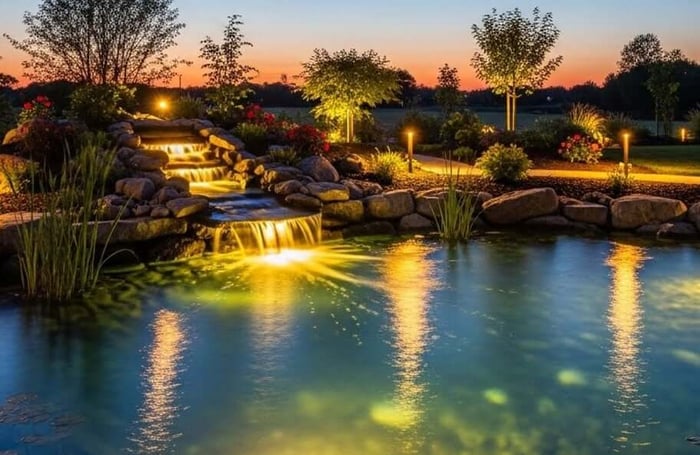
Good lighting is what makes a pond feel “done.” It’s the difference between a dark backyard and a space you can actually enjoy at night. The best part? You do not need a huge lighting project to make a big change.
If you have tried lighting before and it did not look right, it is usually one of these issues:
- The wrong type of light for the job
- The light is aimed the wrong way
- The system is missing the right power and controls
This guide fixes all three by breaking lighting down by application.
Landscape Lighting


Landscape lighting is used to highlight things like plants, rocks, pond edges, and walls. It is for looks first, safety second.
What makes it “landscape lighting”?
- It aims at a feature (plant, rock, wall), not the ground you walk on.
- It often has an adjustable head so you can aim it where you want.
- Some models can be used in the yard or underwater, which makes them very flexible.
Great places to use it around a pond:
- Point it up into a tree or tall plant behind the pond to add depth.
- Aim it across boulders or shoreline rocks to show texture.
- Light one big feature near the pond so your eyes have a focal point at night.
Quick tip for a clean, high-end look:
Pick 2 or 3 features you want to show off most. Light those first. Try not to see the bulb itself. Hide the fixture behind a rock or plant and aim it carefully.
- Encore Brass Bullet, Rotatable, Telescopic Shroud, 3w LED
- Oase ProfiLux Garden LED RGB Lights
- Anjon 1-Watt Bronze Spot Light w/ Hood
Pathway Lighting


Pathway lighting is for safety and guidance. It helps people see where to walk, especially near water, steps, and bridges.
What makes it “pathway lighting”?
- It shines down and out, making soft pools of light on the path.
- It controls glare, so guests are not looking into a bright bulb.
- Its job is to guide feet, not to spotlight a plant.
Where it matters most around ponds:
- Steps leading down to the pond
- Walkways close to the pond edge
- Bridges, stepping stones, and narrow passes by streams
Spacing made simple:
Place path lights so the light overlaps a little, with no big dark gaps. A simple starting point is about 10 to 15 feet apart, then adjust for curves, steps, and tight areas.
- Encore Brass Perfect Post Pathway, 8" Shade, 3w LED
- EasyPro 4 Watt LED Rock Light
- Solar Path & Lawn Lights (12-Pack)
Waterfall Lighting


Waterfall lighting is made to show moving water. Done right, it can turn a small waterfall into the main feature at night.
What makes it “waterfall lighting”?
- It lights the water sheet or splash area (not just the rocks).
- It is often hidden under a spillway lip or tucked into rock work.
- It needs careful aiming to avoid glare reflecting off the water.
The easiest waterfall “wow” setup:
Put an underwater LED light strip or puck light under the spillway lip (or under the edge where the water starts). When the light is hidden, the water itself looks like it is glowing.
Warm white vs color options:
- Warm white: natural, relaxing, looks good every night.
- Blue: dramatic and modern.
- Color-changing (RGB): fun for entertaining; best used as an option, not the only light.
- Anjon 1 Watt Brass LED Puck Light
- EasyPro 11" LED Light Strip – BLUE
- Atlantic 1 Watt Color Changing Pond Light Kit
Common mistake to avoid:
Do not aim a bright light straight into the main viewing spot. If you see glare, shift the light to the side, aim it lower, or hide it better.
Underwater (Submersible) Lighting


Underwater lighting helps you see fish and the pond shape after dark. It also makes the pond feel deeper and more alive.
What makes it “submersible”?
- It is sealed and made to run underwater.
- It is built for ponds and water features.
- It can be placed on the pond floor, between rocks, or aimed along a wall.
How to keep it looking natural:
Aim underwater lights across the pond, not straight up. Side lighting shows off rock texture and fish movement without blinding you.
Warm white vs RGB underwater:
- Warm white: best for everyday use and natural-looking fish and rocks.
- RGB: great for events; pick one color most nights instead of cycling.
- EasyPro 9 Watt Stainless Steel LED Light
- EasyPro 3-Pack Mini LED Rock Light Kit w/ Transformer
- Atlantic 1 Watt Color Changing Pond Light Kit
Solar Lighting
'


Solar lighting is popular because it is easy. No transformer, no long wiring runs. It is best for a soft glow and quick upgrades.
What makes it “solar”?
- It charges during the day and turns on automatically at night.
- It is best for mood lighting and light path guidance.
Set the right expectations:
If you want strong, consistent lighting every night, low-voltage LED is usually the better choice. Solar is perfect when you want easy ambience.
LED vs Halogen vs RGB (Color-Changing): Simple Guide
- LED: long life, low power use, great for most ponds and yards.
- Halogen: bright warm look, but uses more power and runs hotter.
- RGB: lets you pick colors and effects; best when used intentionally.
Do Not Skip the Power and Controls
- Photocell: turns lights on automatically at dusk.
- Timer: runs lights for a set number of hours.
- Transformer: powers low-voltage lighting and allows easy expansion.
The Easiest Way to Start (3-Step Plan)
- Start with one waterfall light for the biggest impact.
- Add one or two underwater lights so the pond does not go dark.
- Add path lighting anywhere people walk near water.
Quick Lighting FAQ
How many lights do I need?
Start small. One waterfall light plus one or two underwater accents is often enough.
How bright should the lights be?
Brighter is not always better. A soft glow with a few focal points looks best.
Should I choose warm white or color-changing?
Warm white is best for everyday use. Color-changing is great for parties and holidays.
Do I need a transformer?
Yes, for low-voltage lighting. It powers the system and allows automatic control.
Need help choosing the right lights? Feel free to reach out to one of our technicians for assistance at any time.